Fable 5.2 Review 2026: Benchmarks, Pricing, Features, and Real-World Performance
Anthropic released Claude Fable 5.2 on November 9, 2026, positioning it as a frontier model for demanding reasoning, agentic coding, scientific research, and long-running tasks. The release also introduced Claude Mythos 5.2, a version with the same underlying model but a more restricted access path for vetted cybersecurity and life-sciences organizations.
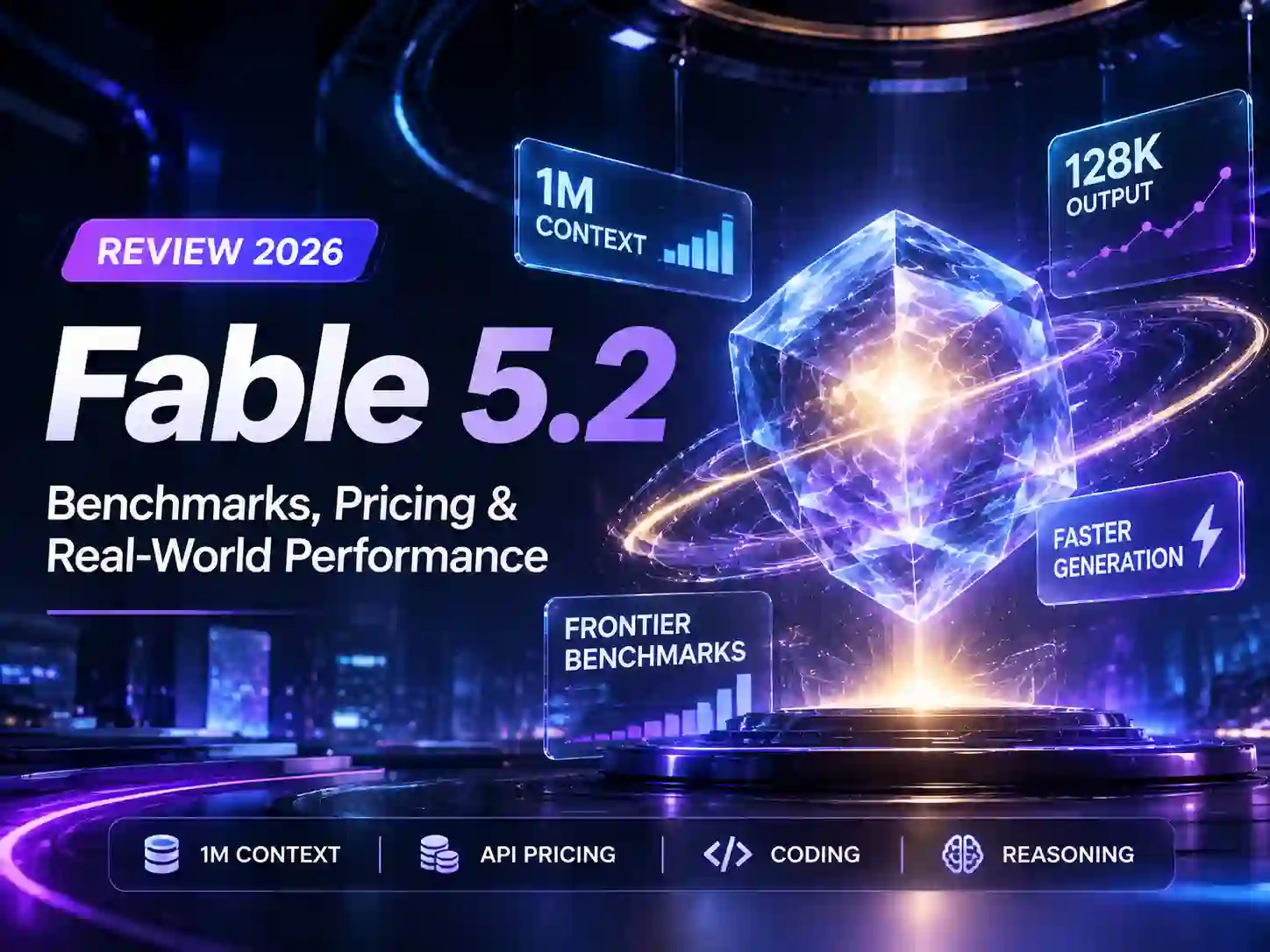
The headline numbers look impressive: a 1-million-token context window, up to 128K output tokens, API pricing starting at $8 per million input tokens, and output generation that Anthropic says is up to 30% faster than Fable 5.1. Its published benchmarks also show substantial gains over the previous generation.
But does that make Fable 5.2 the best Claude model for everyone? Not necessarily. Its higher per-token price than Opus 5.5, potentially heavy agent usage, and the gap between benchmark performance and everyday work all matter.
We reviewed Anthropic’s announcement and model documentation, compared the published benchmarks and pricing, and examined early discussions on Reddit, Hacker News, and creator channels. Here’s what Fable 5.2 actually offers, where it stands out, what early users are reporting, and when it makes sense to use it.
What Is Fable 5.2?
Claude Fable 5.2 is Anthropic’s advanced AI model for complex reasoning and long-horizon agentic work. Rather than focusing only on quick question-and-answer exchanges, it is designed to work through demanding tasks over extended sessions: analyzing large codebases, conducting multi-step research, coordinating subagents, checking results, and carrying work through to a finished deliverable.
Its official API model ID is claude-fable-5-2. The model accepts text and image inputs and generates text output.
Anthropic launched Fable 5.2 alongside Claude Mythos 5.2. The two share the same underlying model and core specifications. Fable includes strong cybersecurity and biology safeguards so it can be made broadly available. Mythos is offered through Anthropic’s verification programs to eligible organizations working in areas such as cybersecurity and life-sciences research.
Anthropic recommends Fable and Mythos for ambitious, open-ended technical work. For most everyday coding and knowledge tasks, the company suggests starting with Claude Opus 5.5 and moving to Fable when the task requires more capability.
Fable 5.2 at a Glance
| Specification | Claude Fable 5.2 |
|---|---|
| Developer | Anthropic |
| Release date | November 9, 2026 |
| Model ID | claude-fable-5-2 |
| Context window | 1 million tokens |
| Maximum output | 128K tokens |
| Input | Text and images |
| Output | Text |
| Standard API input price | $8 per million tokens |
| Standard API output price | $40 per million tokens |
| Fast mode input price | $16 per million tokens |
| Fast mode output price | $80 per million tokens |
| Main strengths | Reasoning, agentic coding, research, long-running tasks |
| Public access | Claude apps and supported developer platforms |
Note: API pricing is subject to change. Check Anthropic’s official pricing page for the latest rates and detailed pricing information, including prompt caching and Batch API discounts.
The model’s knowledge and training data cutoff is June 2026, according to Anthropic’s platform documentation. A 1-million-token context window gives it room to work with large inputs, but it does not guarantee that every detail in a long document will be retrieved or interpreted correctly.
Key Features of Claude Fable 5.2
1. Stronger Reasoning for Complex, Multi-Step Tasks
Fable 5.2 is designed to tackle problems that require more than a single response. It can break down an ambiguous request, develop a plan, use tools, check intermediate results, and continue working toward a finished outcome.
Anthropic describes use cases such as multi-hour agent sessions, deep research, and analysis that produces a complete document, spreadsheet, or presentation. This makes the model particularly relevant to software engineering, data analysis, scientific work, and other tasks where a sequence of decisions matters as much as the final answer.
2. Agentic Coding and Subagent Orchestration
One of the biggest themes in Anthropic’s launch announcement is Fable 5.2’s ability to coordinate multiple agents. In one internal experiment, an Anthropic engineer asked the model to build a prototype operating system from an empty folder. The system coordinated more than 1,000 subagents over eight days, producing a working OS with a kernel, drivers, file storage, windows, a login screen, and an installer.
This is an impressive demonstration of long-running agent coordination, but it should not be mistaken for a typical one-prompt result. It involved a large multi-agent setup, sustained execution, and extensive work over several days.
For developers, the practical value is the model’s ability to investigate unfamiliar code, divide work into smaller tasks, review changes, and iterate. The trade-off is that every additional agent and tool call can increase total usage.
3. Faster Output and Better Efficiency
Anthropic says Fable 5.2 generates output up to 30% faster than Fable 5.1. It also reports that the new model can complete challenging tasks with fewer tokens at Medium effort.
An optional Fast mode can increase token generation speed by up to 2.5 times. However, Fast mode doubles the standard input and output token prices, so it is best treated as a latency option rather than a general cost-saving setting.
Faster token generation also does not automatically mean a task will finish 30% sooner. Tool execution, agent coordination, retries, and the complexity of the task can all affect end-to-end time.
4. A 1-Million-Token Context Window
Fable 5.2 supports a context window of up to 1 million tokens and a maximum output of 128K tokens. This gives it room to process large codebases, lengthy research materials, technical documentation, and multiple related files in one workflow.
For teams working with long specifications or complex projects, a large context window can reduce the need to split information into many separate conversations. Still, context capacity is not the same as perfect recall: important details should be checked, and critical outputs should be verified against the original source.
5. Improved Vision and Clearer Communication
Anthropic reports improvements in vision and says testers found Fable 5.2 communicates more clearly than earlier Fable and Mythos models.
Early users have also described giving the model screenshots of broken interfaces and asking it to diagnose the problem. This is a useful example of combining visual input with reasoning: the model can inspect a screenshot, explain what appears wrong, and suggest a plan for fixing it.
Its visual capability should not be confused with image generation. Fable 5.2 can analyze image inputs, but its documented output modality is text.
6. Fewer Unnecessary Safety Blocks
Anthropic says Fable 5.2’s cybersecurity and biology safeguards are as robust as those in Fable 5.1, while producing approximately 55% fewer unnecessary blocks in early testing. The company reports reductions of around 60% for cybersecurity and 40% for biology.
This does not mean Fable 5.2 has unrestricted access to sensitive technical tasks. High-risk cybersecurity requests, such as exploit generation and certain vulnerability activities, and many research-biology requests remain subject to safeguards. Eligible organizations that need access to less-restricted capabilities can apply for Mythos through Anthropic’s verification programs.
Fable 5.2 Benchmarks: How Good Is It?
Anthropic’s published benchmark results show substantial improvements over Fable 5.1 and strong performance against Opus 5.5 and other frontier models. The results cover agentic coding, business workflows, scientific research, multidisciplinary reasoning, and visual chart recognition.
Here are selected results from Anthropic’s launch announcement:
| Benchmark | Fable 5.2 | Fable 5.1 | Opus 5.5 | GPT-6 Astra | Gemini 4 Carbon |
|---|---|---|---|---|---|
| FrontierCode 2.0 | 49.1% (Xhigh) | 32.4% (Xhigh) | 45.5% | 42.8% | 41.1% (Medium) |
| FrontierSWE v2 | 69.9% | 56.3% | 62.3% | 65.5% | 61.2% |
| AutomationBench | 51.4% | 31.4% | 42.5% | 41.4% | 53.9% |
| Terminal-Bench-Science 0.1 | 74.6% | 52.6% | 58.7% | 68.1% | 64.8% |
| Humanity’s Last Exam (with tools) | 74.2% | 65.6% | 67.7% | 57.2% | — |
| Chartography (no tools) | 73.4% | 44.8% | 64.4% | 71.0% | 72.5% |
A few results stand out:
- Agentic coding: Fable 5.2 reaches 49.1% on FrontierCode 2.0 at Xhigh effort, compared with 32.4% for Fable 5.1 and 45.5% for Opus 5.5.
- Software engineering: Its 69.9% result on FrontierSWE v2 is higher than the listed scores for Fable 5.1, Opus 5.5, GPT-6 Astra, and Gemini 4 Carbon.
- Business workflows: Fable 5.2 improves from 31.4% to 51.4% on AutomationBench, although Gemini 4 Carbon scores higher at 53.9%.
- Scientific research: It scores 74.6% on Terminal-Bench-Science 0.1, ahead of the listed Opus 5.5 and GPT-6 Astra results.
- Visual chart recognition: Its 73.4% score on Chartography is higher than the other listed models in this comparison.
These numbers are useful, but they need context. The table combines different evaluation tasks and effort settings. Anthropic says the models’ scores generally use their highest available effort, and the results are not a guarantee that Fable 5.2 will outperform every competitor on a specific real-world workload.
Independent evaluation pages also report strong results, but their rankings depend on the benchmark, harness, effort level, and cost methodology. For example, Artificial Analysis publishes a separate Fable 5.2 versus Opus 5.5 comparison. It is better to compare models on the same benchmark and configuration than to combine scores from unrelated leaderboards.
Our takeaway: Fable 5.2 has a compelling benchmark profile, particularly for demanding coding and research tasks. The most useful test is still to run your own difficult tasks against the model you currently use and compare both the quality of the result and the total cost.
Pros and Cons of Fable 5.2
Pros
- Major improvement over Fable 5.1: Anthropic’s published results show meaningful gains across coding, business workflows, research, and visual reasoning.
- Built for long-running work: It can plan, execute, review, and iterate across complex tasks rather than stopping after a single answer.
- Strong agent coordination: Its ability to delegate work to subagents is useful for large engineering and research projects.
- Faster output: Anthropic reports up to 30% faster output generation than Fable 5.1.
- Lower API rates than Fable 5.1: Standard input and output prices are each 20% lower.
- Large context and output limits: A 1M-token context window and 128K maximum output support large projects and lengthy deliverables.
- Improved safety usability: Anthropic reports fewer unnecessary safety blocks while retaining its safeguards.
Cons
- More expensive per token than Opus 5.5: Fable 5.2 costs twice as much per input and output token at standard API rates.
- Potentially high task costs: Long-running sessions, repeated reasoning, and multiple subagents can consume substantial usage.
- Fast mode costs more: Its token rates are double the standard Fable 5.2 rates.
- Not necessary for everyday tasks: Anthropic itself recommends Opus 5.5 as the starting point for most coding and knowledge work.
- Early user experiences vary: Launch-day reports are useful signals, but they are not controlled, representative tests.
- Not a native video generator: It can help with creative planning and scripts, but it does not directly produce finished AI videos.
Fable 5.2 Pricing: API Costs and Subscription Access
Fable 5.2 has lower standard API token prices than Fable 5.1, but it remains more expensive per token than Opus 5.5.
Claude API Pricing
| Pricing | Fable 5.2 | Fable 5.1 | Opus 5.5 |
|---|---|---|---|
| Input (per 1M tokens) | $8 | $10 | $4 |
| Output (per 1M tokens) | $40 | $50 | $20 |
| Fast mode input | $16 | — | — |
| Fast mode output | $80 | — | — |
| Cache reads (per 1M tokens) | $0.20 | $0.25 | $0.20 |
Fable 5.2’s standard input and output prices are 20% lower than Fable 5.1’s. However, both standard rates are twice the corresponding Opus 5.5 rates.
Anthropic also offers prompt caching and Batch API pricing options. Batch API provides a 50% discount on input and output tokens, while cache reads can make repeated requests more economical when the same context is reused. Check the current official pricing page for eligibility and the latest terms before estimating a production workload.
Why the Actual Cost Can Be Higher Than the Token Price Suggests
A model’s price per million tokens does not tell you how much a completed task will cost. Fable 5.2 is designed to work through complicated tasks, and that can involve:
- Multiple reasoning and review cycles.
- Tool calls and repeated code execution.
- Subagents working in parallel or in nested workflows.
- Large input contexts and long generated outputs.
- Retries when a test or intermediate result fails.
Early Reddit and Hacker News discussions include reports of rapid usage consumption when users set high effort or allow the model to launch many subagents. These are individual reports rather than a reliable average, but they highlight why teams should monitor total task usage.
A sensible approach is to start with Medium effort for a representative task, set clear limits on subagents, and measure the cost of a successful result before increasing effort or enabling Fast mode.
Can You Use Fable 5.2 for Free?
Fable 5.2 is not a generally free model with unlimited access. Availability and usage depend on the Claude plan or developer platform.
At launch, Anthropic announced additional Fable usage for eligible paid subscribers. Pro plans and standard Team seats could use Fable for up to 50% of weekly usage limits during the promotion, with one to three usage resets depending on subscription history. The launch promotion was time-limited, so check your Claude usage page and Anthropic’s current plan terms rather than assuming the offer remains available.
API use is billed separately according to token consumption.
Fable 5.2 vs Opus 5.5: Which Model Should You Use?
Fable 5.2 and Opus 5.5 serve different roles in Anthropic’s model lineup. Fable is designed for more demanding reasoning and long-horizon agentic work, while Opus is positioned as the stronger everyday starting point for most coding and knowledge tasks.
| Category | Fable 5.2 | Opus 5.5 |
|---|---|---|
| Main focus | Demanding reasoning and long-horizon agentic work | General coding and knowledge work |
| Context window | 1M tokens | 1M tokens |
| Maximum output | 128K tokens | 128K tokens |
| Input price | $8 / 1M tokens | $4 / 1M tokens |
| Output price | $40 / 1M tokens | $20 / 1M tokens |
| Best fit | Complex tasks that need deeper reasoning and extended execution | Everyday development, analysis, and knowledge work |
Choose Fable 5.2 When:
- Your Opus 5.5 workflow consistently fails on a difficult task.
- You need a model to investigate a large codebase and work through multiple stages.
- You are running multi-hour agent sessions or complex research workflows.
- The quality improvement is worth the higher potential task cost.
- You need the model to coordinate subtasks, review results, and continue iterating.
Choose Opus 5.5 When:
- You are handling everyday coding and knowledge work.
- Your existing prompts and workflows already produce reliable results.
- Cost efficiency matters more than the last improvement in capability.
- You do not need multiple agents or long-running execution.
The practical recommendation is simple: start with Opus 5.5, then move to Fable 5.2 when your own evaluation shows that Opus is not good enough for the task. That is also consistent with Anthropic’s guidance.
Fable 5.2 vs GLM 5.2: What Should You Compare?
Searches for GLM 5.2 vs Fable reflect a broader question: should you choose the most capable model for difficult work or a lower-cost alternative that is good enough for your workflow?
A useful comparison should not rely on a single overall ranking. Check the exact GLM model version and provider, then compare both models on the same tasks:
| What to Compare | Why It Matters |
|---|---|
| Coding accuracy | Can the model solve your actual repository or debugging tasks? |
| Reasoning quality | Does it handle ambiguous, multi-step problems reliably? |
| Agent support | Can it use tools, delegate tasks, and verify results? |
| Context window | Can it process the documents or codebase you need? |
| Input and output pricing | What will the workload cost at your expected token volume? |
| Speed and latency | How long does a complete task take, not just the first response? |
| Availability | Can you access the model through your preferred API or application? |
Fable 5.2 has an official published specification and benchmark set from Anthropic. Third-party GLM comparisons should be checked against the model provider’s current documentation and a consistent evaluation setup. We would not treat an unverified blended-price ranking or a benchmark from a different testing harness as a definitive winner.
For a fair test, use the same coding task, context, tool permissions, and success criteria. Record the final result, time taken, and total cost. That will tell you more than a headline leaderboard.
What Are Users Saying About Fable 5.2?
Fable 5.2 launched on November 9, 2026, so public feedback is still early. The initial discussions on Reddit, Hacker News, and creator channels reveal several recurring themes.
1. Users Notice the Speed and Reasoning Improvements
In an early r/ClaudeAI review, one user reported that Fable 5.2 felt faster than 5.1 and that Medium effort was sufficient for the tasks they tested. The same post described using a screenshot to diagnose a UI issue and recommended asking Fable to review work produced by an earlier model.
These are useful first impressions, not a controlled benchmark. Still, they suggest two practical first tests: give Fable a task that an earlier model struggled with, and ask it to inspect an existing project for problems.
2. Subagents Can Consume Usage Quickly
A recurring concern is the amount of usage Fable 5.2 can consume when it launches multiple agents.
Some Reddit users reported that high-effort sessions and parallel subagents used a substantial share of their available limits in a short time. Other early discussions describe the model as impressive but expensive to run for extended tasks.
The lesson is not that every Fable session will be costly. It is that agent configuration matters. Set limits, watch usage, and avoid using the most expensive effort setting for tasks that do not need it.
3. Opus 5.5 May Be Enough for Ordinary Coding
Some Hacker News users said they had difficulty noticing a meaningful difference between Fable 5.2 and Opus 5.5 on ordinary coding requests. The distinction became more apparent when the task was made more ambitious or required deeper reasoning.
That is consistent with Anthropic’s own recommendation to start with Opus for most everyday work and use Fable when the task demands more.
4. Creators Are Testing More Than Code
Early creator demonstrations have explored games, spreadsheets, visual projects, 3D designs, and animated marketing content. Claire Vo’s first-look review, for example, describes turning a social post and brand materials into an animated marketing video, alongside other hands-on experiments.
These examples show how a reasoning model can support a creative workflow. They do not mean Fable 5.2 is a dedicated video-generation model: it can help develop the concept and production plan, while a separate video tool is needed to generate the finished footage.
How to Use Fable 5.2 for Creative Work
Although Fable 5.2 is primarily designed for technical and reasoning-heavy tasks, its ability to interpret instructions, analyze images, and plan multi-step work can also help creators.
For example, you can ask it to:
- Turn a rough idea into a structured video concept.
- Write a short-form video script with a hook, scenes, and a call to action.
- Analyze a reference image and describe its composition, lighting, camera angle, and visual style.
- Create detailed text-to-video or image-to-video prompts for a separate generation tool.
- Develop several creative directions for a product launch or social media campaign.
- Review a draft script and identify weak pacing, unclear messaging, or missing scenes.
A useful prompt might look like this:
I want to create a 30-second product video for a new skincare brand. Develop three creative concepts for TikTok and Instagram Reels. For each concept, provide a hook, a scene-by-scene storyboard, camera directions, visual style, voiceover, on-screen text, and a detailed AI video prompt for every scene. Keep the product packaging and brand colors consistent throughout.
Fable can help structure the creative work and produce the instructions. You will still need a dedicated image or video generation platform to turn those instructions into visual assets.
From Fable 5.2 Ideas to AI Videos: Bring Your Concepts to Life with Anijam 🔥
Fable 5.2 can help you think through a creative idea, write a script, analyze visual references, and build a detailed production plan. But turning that plan into a finished video requires a different kind of AI tool.
That’s where Anijam AI fits into the workflow.
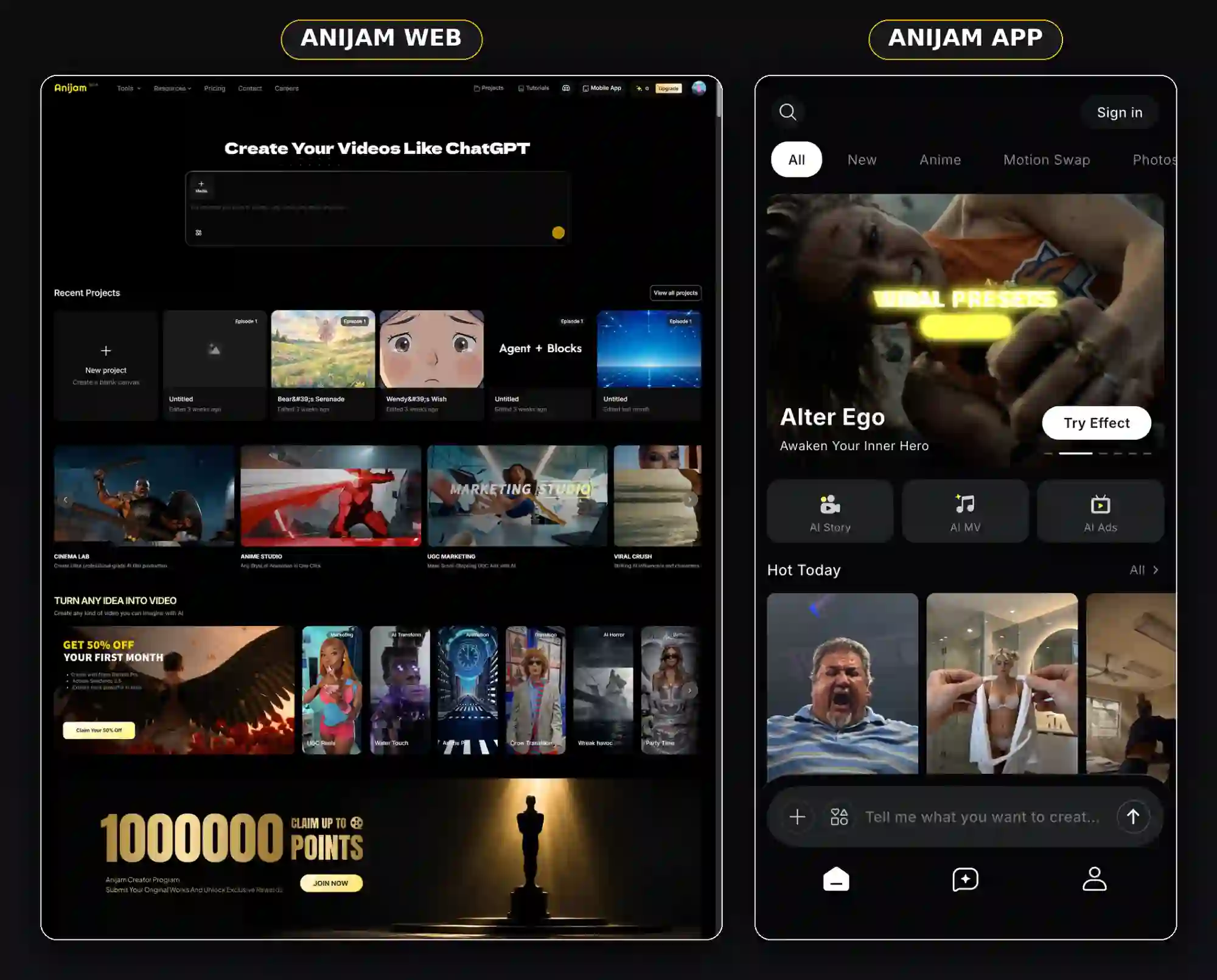
Anijam is an AI creative platform built around an AI Video Agent, video generation tools, and trending templates. You can bring in an idea, script, reference image, product photo, or audio file, then use the AI Video Agent to develop the story, create consistent characters, generate scenes, add voices and lip sync, and refine the result on a timeline.
Step 1: Develop the Concept and Script with Fable 5.2
Start with your campaign idea, story, or product brief. Ask Fable 5.2 to develop the concept, write the script, organize the scenes, and describe the visual direction.
You can also provide reference images for it to analyze. Ask for clear descriptions of the subject, composition, camera movement, lighting, and style so you have a useful creative brief before video production begins.
Step 2: Turn Your Idea into a Video with Anijam
Bring your script, visual references, or product photo into Anijam’s AI Video Agent. Instead of generating only one disconnected clip, the agent can plan the story, create characters, generate scenes, and coordinate voice and lip sync as part of a connected production workflow.
For creators who want to start faster, Anijam also offers a regularly updated library of trending AI video templates. You can choose a format, adapt it to your subject, and build from an existing creative direction instead of starting with a blank prompt.
Step 3: Refine Scenes and Export Your Video
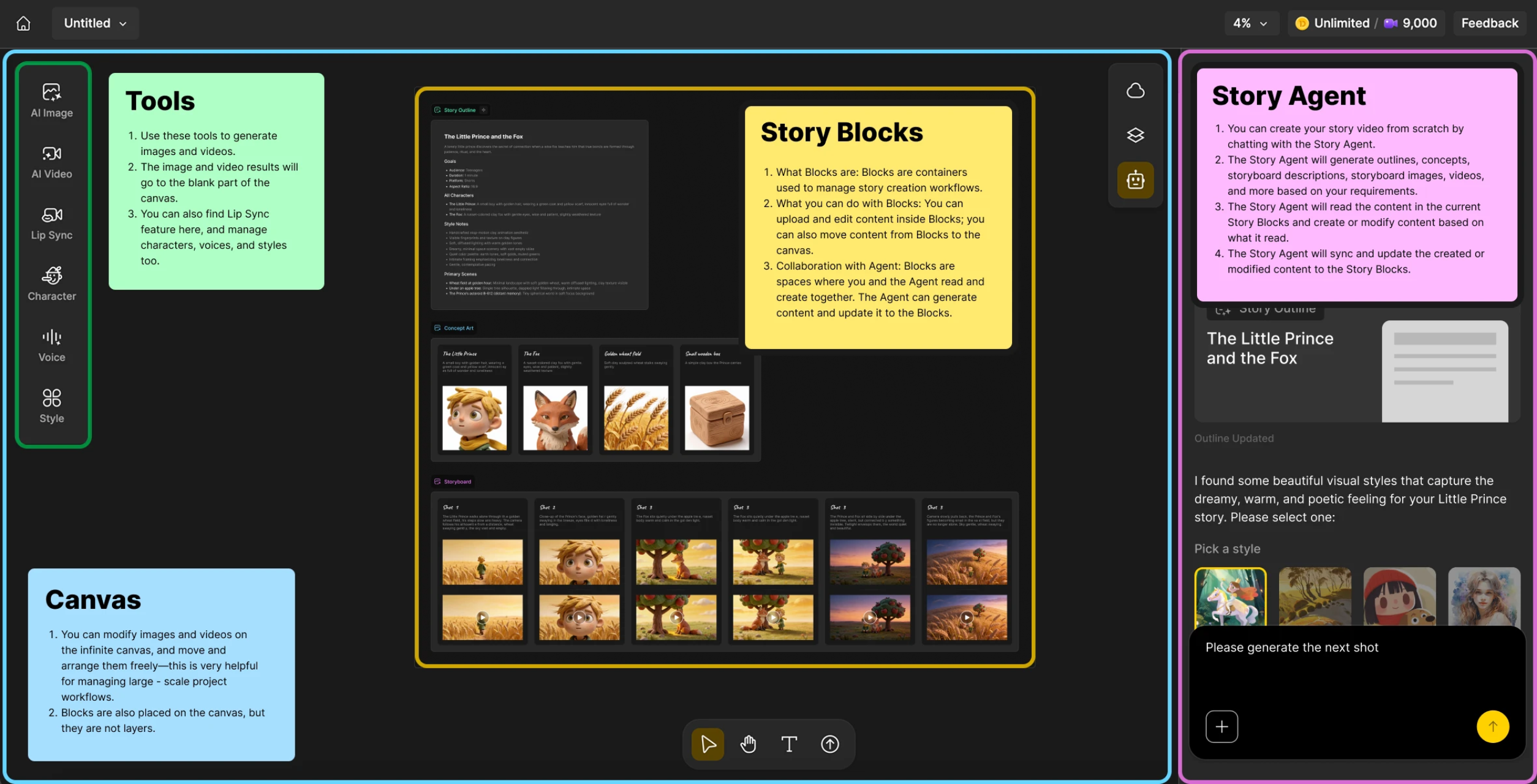
Once the scenes are generated, use Anijam’s canvas and timeline editor to adjust pacing, camera movement, dialogue timing, lip sync, and transitions. You can combine generated clips, refine individual scenes, and prepare the final video for social media, product marketing, or storytelling.
The two tools serve different roles: Fable 5.2 helps develop and organize the thinking behind a project, while Anijam helps turn creative direction into video content.
If you want to move from an idea or script to a complete AI-generated video, try Anijam AI.
Is Fable 5.2 Worth It?
Fable 5.2 is a meaningful upgrade over Fable 5.1. Anthropic’s published benchmarks show stronger results across several demanding tasks, and the new model combines a large context window, faster output, and more capable long-running agent workflows.
However, it is not automatically the right choice for every user. Its standard API rates are twice those of Opus 5.5, and early community feedback suggests that agent-heavy workflows can consume usage quickly. For routine coding, writing, and knowledge work, Opus 5.5 may remain the more economical choice.
Fable 5.2 makes the most sense when the task is genuinely difficult: a complex codebase, a multi-step research project, a demanding technical analysis, or a workflow that benefits from planning, delegation, and repeated verification.
Frequently Asked Questions
What is Fable 5.2?
Claude Fable 5.2 is Anthropic’s advanced AI model for demanding reasoning and long-horizon agentic work. It is designed for complex coding, research, analysis, and multi-step tasks that may require extended execution and tool use.
When was Claude Fable 5.2 released?
Anthropic officially released Claude Fable 5.2 on November 9, 2026, alongside Claude Mythos 5.2.
How much does Fable 5.2 cost?
The standard API price is $8 per million input tokens and $40 per million output tokens. Optional Fast mode costs $16 per million input tokens and $80 per million output tokens. Subscription access and usage limits depend on the Claude plan.
Is Fable 5.2 better than Opus 5.5?
Fable 5.2 scores higher than Opus 5.5 on several benchmarks published by Anthropic, particularly for demanding agentic coding and research tasks. However, Opus 5.5 costs half as much per input and output token and remains Anthropic’s recommended starting point for most everyday coding and knowledge work.
What is the difference between Fable 5.2 and Mythos 5.2?
They share the same underlying model and core specifications. Fable 5.2 includes strong cybersecurity and biology safeguards and is broadly available. Mythos 5.2 is offered to eligible organizations through Anthropic’s cybersecurity and life-sciences verification programs.
Does Fable 5.2 support image generation or video generation?
Fable 5.2 supports text and image inputs, but its documented output is text. It can analyze visual references, write scripts, plan scenes, and create prompts for image or video tools. It is not a native image or video generation model.
Does Fable 5.2 have a 1-million-token context window?
Yes. Anthropic’s platform documentation lists a context window of up to 1 million tokens and a maximum output of 128K tokens.
Is Fable 5.2 free to use?
Fable 5.2 is not an unlimited free model. Access depends on the Claude subscription plan or API provider. Anthropic announced a limited launch-period usage promotion for eligible paid subscribers, but users should check their current plan and usage page for availability.
Why does Fable 5.2 use so much usage?
Complex tasks can involve extended reasoning, large contexts, tool calls, retries, and multiple subagents. These activities can increase total token consumption. Start with a lower effort setting, define agent limits, and monitor the cost of each completed task.
by Wendy
Wendy is a passionate writer and AI video enthusiast at Anijam, exploring creative ways to bring stories to life with AI-powered image and video tools. She shares practical tips, prompt ideas, and insights to help creators turn their imagination into engaging visual content.